That thing when you’re traveling alone. You book what looks like a nice hotel, but when you get there all you can think about is Roald Dahl’s Tales of the Unexpected.
It’s not even that there is anything wrong with the place, it’s just that it’s a little empty considering that you supposedly got the last room. The staff are pleasant and attentive, but it’s just too quiet. Stuffy, even.
So after checking in you take your luggage to your room and freshen up, before going back down to the restaurant for a bite to eat. Again, the place is empty, except for the waiter, the guy behind the bar, and whoever mans the kitchen, and of course the mandatory two ladies of a certain age enjoying a cocktail.
You order yourself a drink, a pint of something local, and its brought over to your table on a little paper doily. It has a strange taste taste but you think nothing of it, it’s not that it’s bad, it’s just an unfamiliar brew.
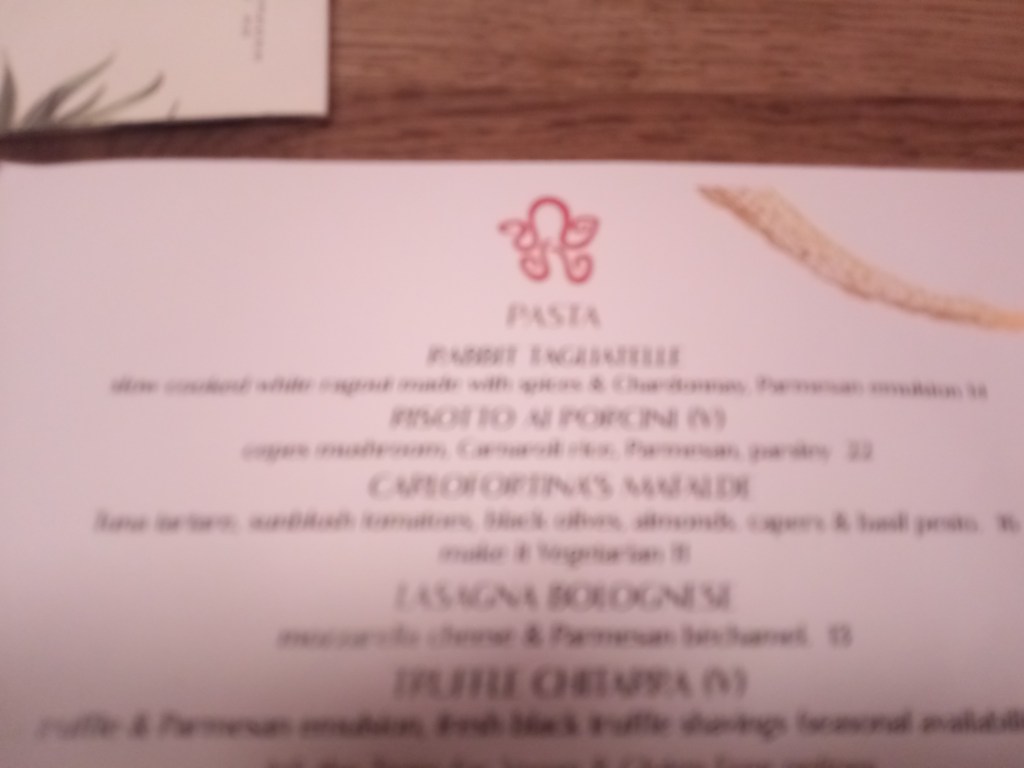
So you finish your drink and you order another one. This time, the bar man brings along the evening menu and without saying a word, he places it on the table next to your drink. Its been a long day and you haven’t eaten since you left the safety and familiarity of your hometown so you pick up the menu and review the options. Perhaps you’re more tired than you might have realised. The words are blurred, difficult to read.
Not recognizing much on the menu, which doesn’t even list prices, you keep it simple, and you order the Rabbit Cacciatore. It comes quickly enough but there isn’t much of it, and the pint you wash it down with still has the strange taste. You order something different for the next one.
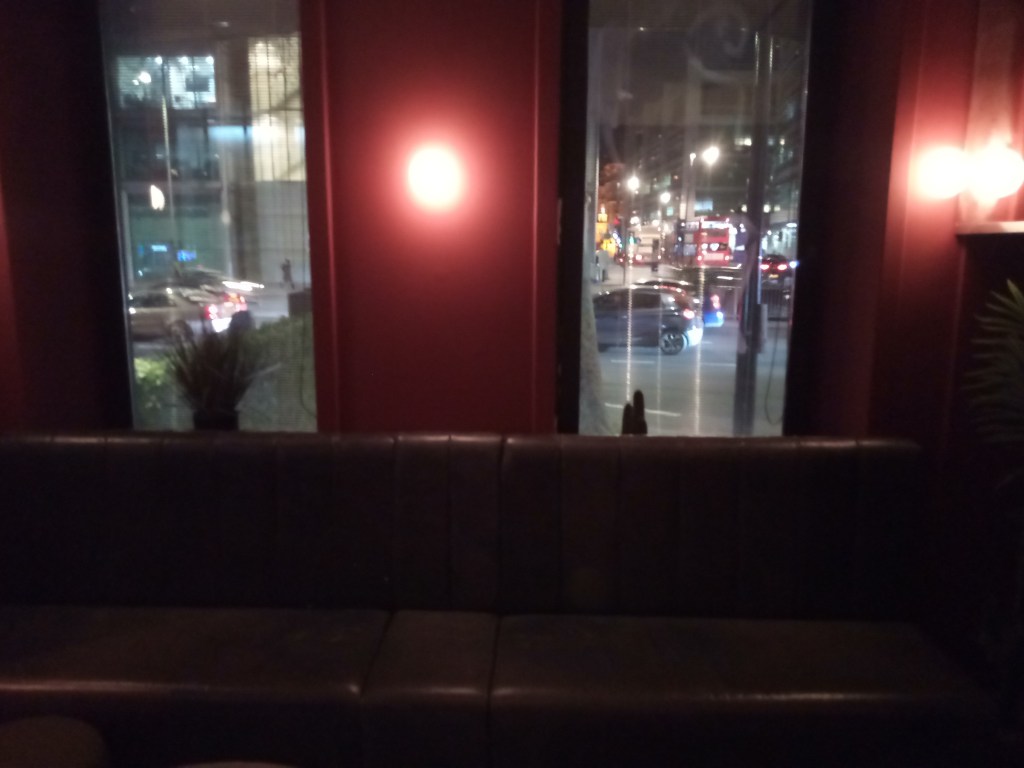
By now, the two ladies of a certain age enjoying a cocktail have left and it’s just you and the bar man. His attentive gaze could be mistaken for willing an early finish, but you decide to stay for a few more pints and order the same again; you receive your pint with a reticent smile from the bar man and take it to a seat by the window where you plan to enjoy the rest of your evening watching the city go by.
Almost immediately, you catch the eye of the homeless guy sitting on the pavement at the entrance to the Underground in the cold February night. The swish and cosy ambiance of the three point five star rated hotel and restaurant is shattered, and you instead decide to hastily finish your pint and retire to your room for a bit of bedtime telly.
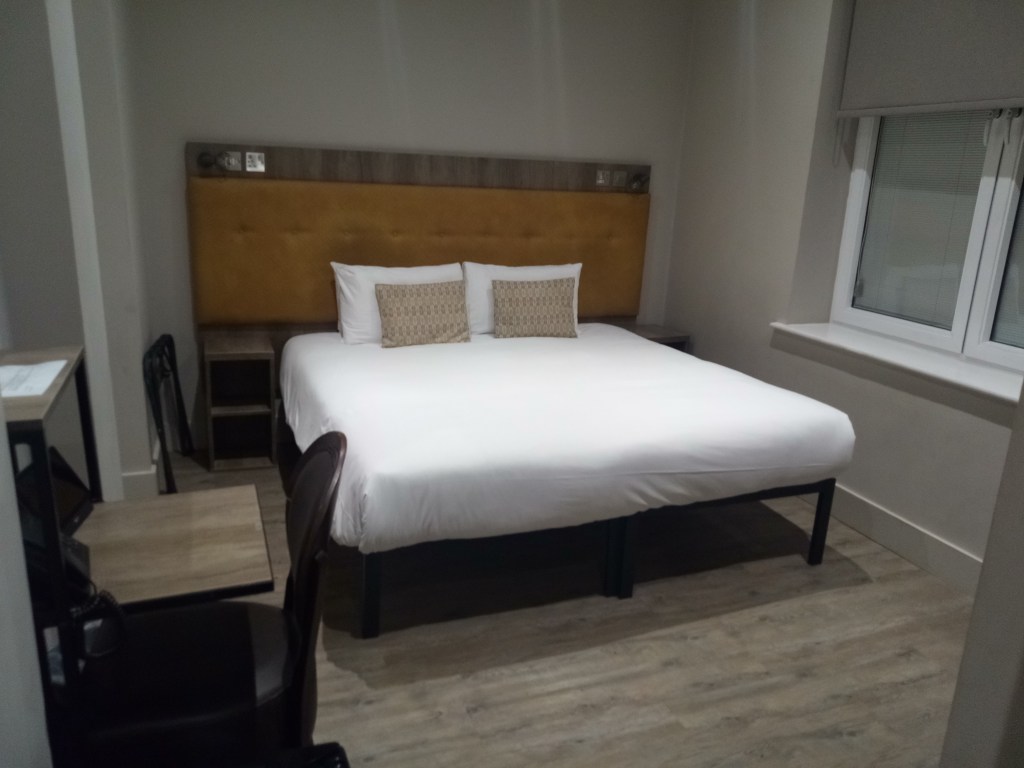
By the time the lift delivers you to your floor, you’re exhausted, drowsy even. You enter your room and close the door behind you, being sure to lock it. Too drained even for a bit of ITV, you recline on to the bed and immediately drift off soundly asleep.
But you don’t sleep long. Soon, there are hushed voices outside the door, and the sound of keys jangle, the door handle crunches the spring inside. Someone, mistakenly, is trying to enter your room.
You sit up, except you don’t, you can’t. You’re pinned to the bed. You call out, but hear nothing but a hushed groan, your words slurred as if drunk, drugged even. You’re heavy. Is something on top of you, is someone in the room? For a moment, you panic, but then it’s over. You’re awake and the room is empty.
“Sleep paralysis is when you can’t move any part of your body right before falling asleep or as you wake up. It happens when your body is in between stages of sleep and wakefulness. An episode is temporary and only lasts for a few seconds to a couple of minutes. It’s a type of parasomnia.”
Sure. Terrifying. But just a dream. But it does raise the interesting question: has your suitcase been moved? Seriously, was that how you left it? Are you sure?
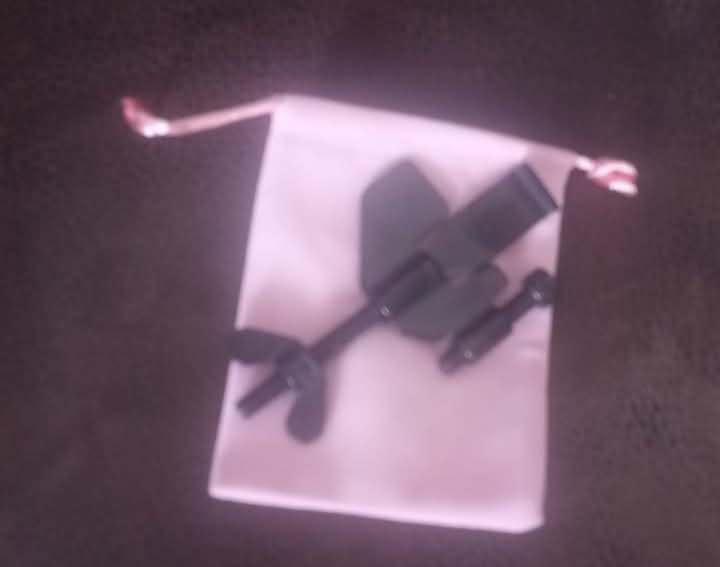
By the fourth or fifth time you’ve done this, you decide, paranoia or not, you need peace of mind, even if it does come in a pretty but blurred pink case.
Can’t believe they didn’t think of these before, Del Griffith and Neal Page sure could have done with one.
It was the voice in my head that said it, but where that originated I’ll never know. Was it my own self loathing, the collective subconscience, God, a stray thought from my wife detected via ESP?
But yes, we were travelling 160 miles to see and photograph a culvert. In my defence, it wasn’t just any culvert, it was where I used to play when I was about six years old.
Possibly still in the weird territory, but this was basically a place where a number of convergent streams dipped underground, and had formed a wide basin with shallow water that was perfect for little feet to splash about.
I hadn’t been there for about thirty years, and even then, the splashing about was ten years before that. But I’d had an idea for something creative that got me thinking of this culvert. In my mind’s eye, this was an idyllic place of sunny days and happy memories. Something Bernstein Bearsy. How nice would it be to go back?
Long springs and longer summers, we played all sorts of games on the grassy field beside it, jumped in the water, built dams. We brought our Transformers and Go-bot toys and waged war in the canyons and long grass. That’s what I remembered.
The reality was actually a bit grim.
It was smaller than I recall, and overgrown. There was no way that this was a place frequented by little feet any more.
Perhaps if I had visited in Summer, it might have been a different story, but this was not what I wanted to see. The wide river basin was barely a foot at its widest. The vast flood plain where we made our base was just grassy mud. The sound of children laughing, gone, as if it never even were.
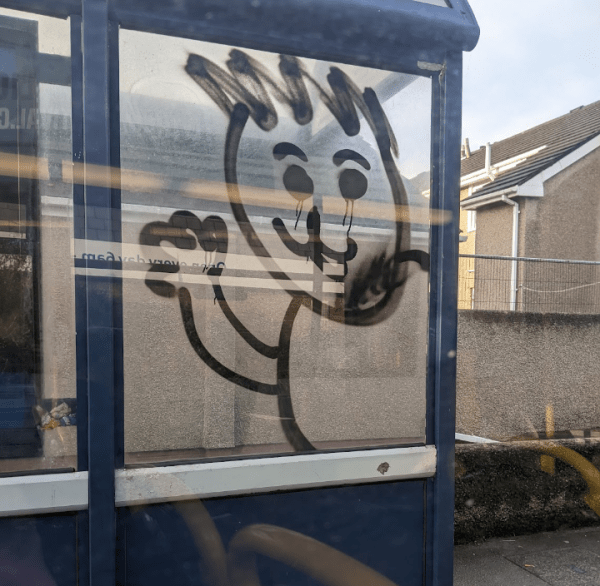
Standing alone at the bus stop. Cold and wet from the rain, but taking shelter beneath the plastic erm shelter.
It’s not that unpleasant. Listening to the rain hit the roof, and then dropping, the pattering sound of large water drops hitting the tarmac.
Letting the buses pass that don’t go my way, some stop, let someone on. Let someone off. The engines shutdown to silence while they’re stationary, gone are the sounds of a diesel ticking over, now that the hybrids are used. Gone too is the diesel smell. I miss that.
I’m not cross about getting the bus, but I am mad at myself for letting it happen. I thought we could manage with one car, but that is stupid. Just because I work from home doesn’t mean there won’t be times I need to travel.
This needs to be a lesson for me. I need to have options. We all need options in life.
Yesterday I caught the vintage Ribble bus. It was just the same as any other bus, but painted in the old colours. I’ve been nostalgic recently for the hour long 226 ride of thirty years ago, sitting in my favourite seat, at the back downstairs to the left. That reassuring whine of the engine, the warmth from it’s heater, the comforting familiarity of every twist and turn and bump in the road. Enough to fill the desires of a man’s heart. What the fuck was I thinking?
Bus shelters are not heated. They are drafty. It was ok when I was a teen. I was a student. I didn’t have any money. Buses got me where I needed to go, on the rare occasions I had somewhere to go, and being a penniless student in the 1990s, those were few and far between, just like the buses.
It brings it home, being stood alone at the bus stop on a cold damp rainy November morning. It’s makes you ask yourself some searching questions, like why am I here? School run. Why am I using the bus? The car is in the garage. Why can’t I walk? It’s ten miles. Why is it ten miles? We moved. Why not change schools? A promise.
In retrospect, telling the children that they would not have to change school before we knew where we would be moving to wasn’t bright. Noted for future reference.
More buses go by, not going where I am going. And cars, lots of cars, taking their drivers exactly where they needed to go, with their warm dry protective bubble. It’s tempting to think, that if all those people were forced to use the bus too, there would be more buses running, and I wouldn’t be stood in a drafty bus shelter on cold wet November morning, and I wouldn’t be considering the outlay of another car.
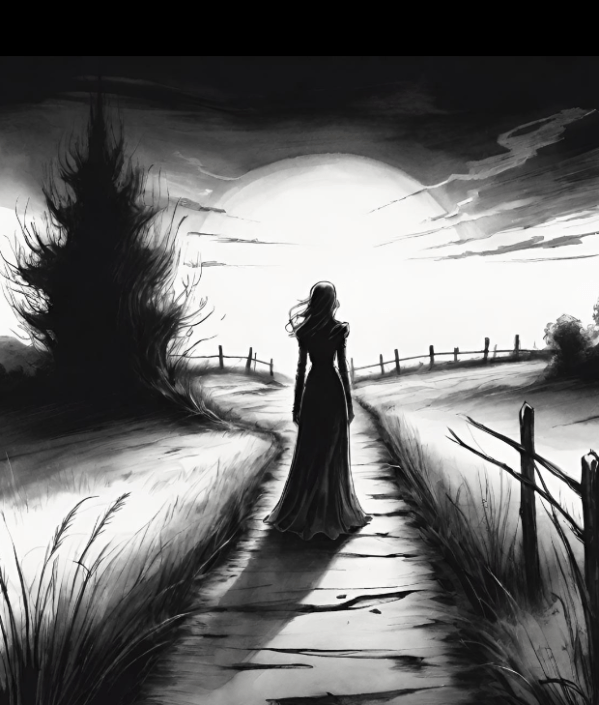
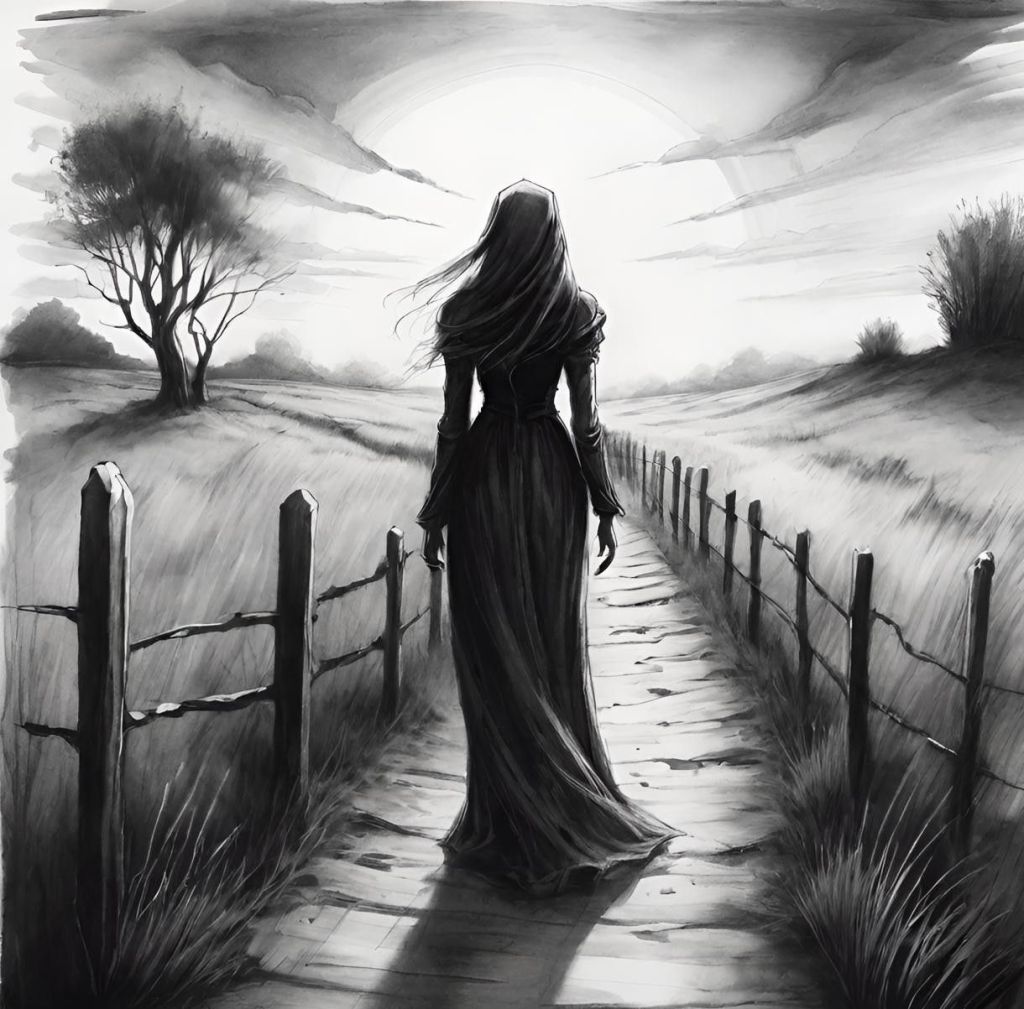
This was back in the Eighties while I was cataloguing the tales of the White Lady, one of England’s more prolific spectres, and it was my last trip of the project that brought me to Thurnscoe in South Yorkshire.
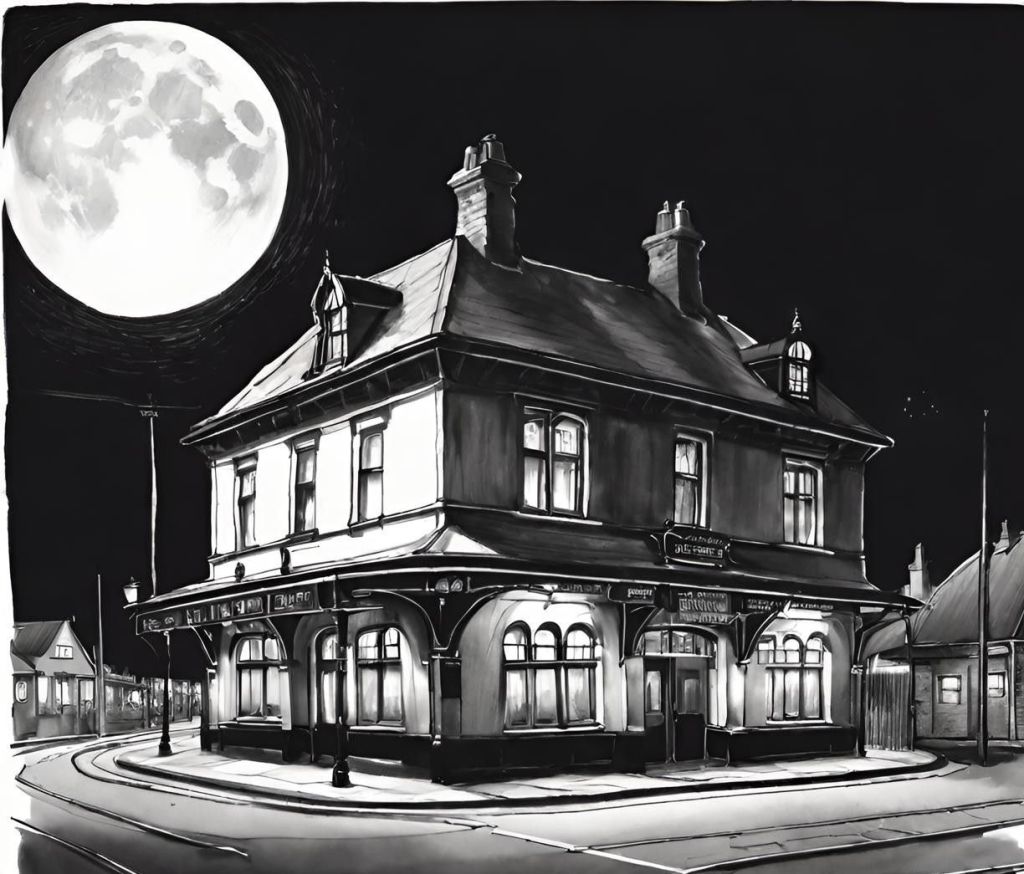
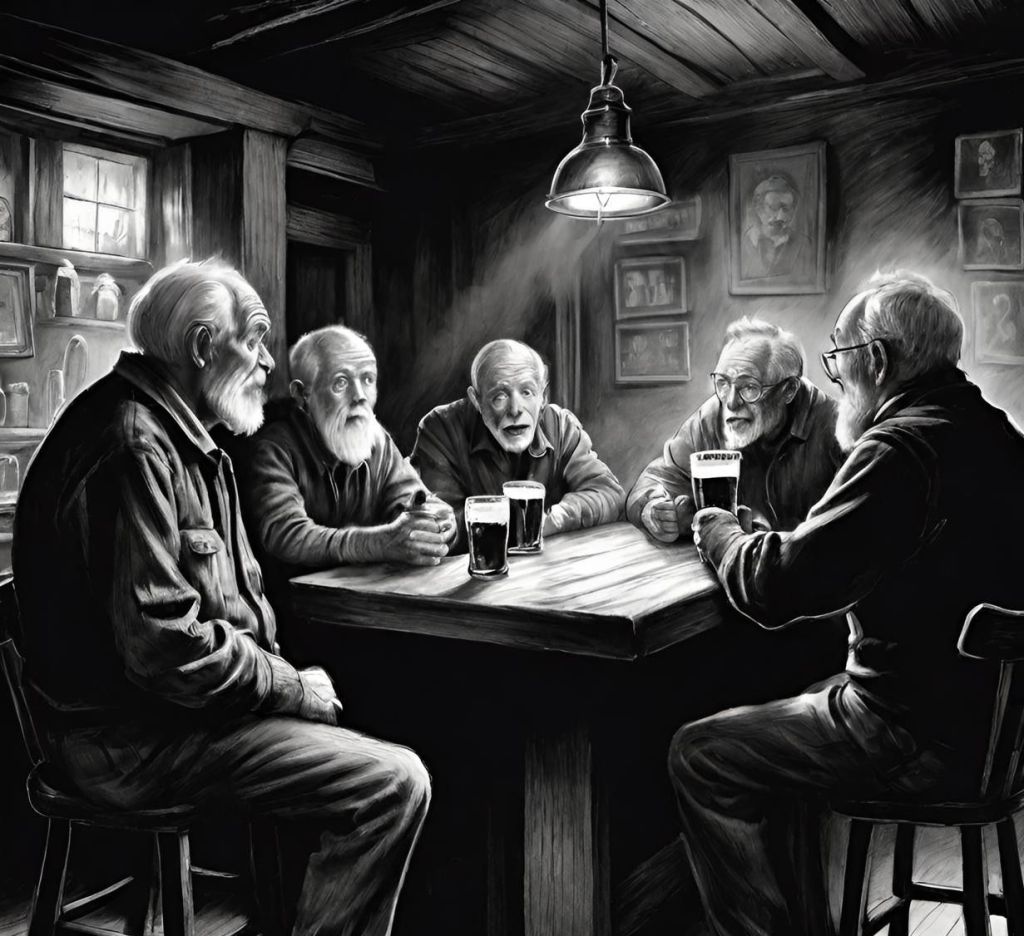
I had found lodgings at the Station Hotel, a pub with seldom used guest rooms run by a feisty middle aged scots woman. What she lacked in height she atoned with fiest and she’d very kindly offered to introduce me to some of the locals that might be of help. As luck would have it, they were all regulars at her bar; an old fashioned working man’s pub, with over bright lighting, threadbare carpet and nicotine stained walls. The tobacco smoke hung thick above the customers, thick as fog, exacerbating my asthma. I couldn’t stay there long.
Everyone I spoke to knew of a different story about the White Lady, where to see her, what she looked like, who she might have been in life. I suppose that made it the oddest thing. While the stories differed, everyone had one. Though few people claimed to have seen her themselves, everyone knew someone that had.
“Hit by a train she was” one of them would say, “taking a short cut back in the 1900s, she stopped for one train but got struck by another, her body was thrown down on to the path with such force that she never knew she’d died, now here she stuck forever looking for a way off the path and back to her home…”
“Raped she was” Another, older, man told me. “Back in the twenties, everyone heard about it. Poor young thing taking a short cut over the heaps…Now her spirit lingers up there, warning travellers to take care and never travel alone…”
“Don’t listen to them” yet another would say, “It was Marian Spitch, wife of Tommy Spitch, she killed herself after the pit collapse back in 1947”
“No no no, they’re all wrong” A haggard old man told me, “She been walking that path long before the pits came. These were milking pastures back in the day, and the white lady was a cow girl, dressed in a white apron…”
The night went on this way, everyone had a theory on who she was, and my note book grew fat with anecdotes, but I had spoken to almost all of the patrons before anyone confessed to having seen her themselves. But maybe that was the alcohol loosening the tongues of the later evening that drew forth the crazier tales.
“I saw her” A younger man, in his twenties, said, “up on the tops. I was walking up Goldthorpe way when it started to rain. Sile it down it did. I was struggling to cover my eyes and keep my cig lit, and I ended up tripping and stumbling on the grass. I got up again and carried on, but I tripped again on a slab or stone or something. When I got up, she was there, stood in front of me, I felt her hand on my shoulder, like ice”
“What did she look like?” I asked him, I was glad of the first hint of a real encounter that entire evening.
“Just white” he said, “I had rain in my eyes and it was dark, couldn’t really make owt out”
“You must have seen something”
“Yeah, she had a face, nose and eyes and stuff, but soon as it twigged what it was, or who, I was outta there. Turned right round, back on the path. I ran home without another glance.”
“Was she old? Young?”
“I said I couldn’t tell, it were dark, shouldn’t have seen her at all up there. That’s how I know she was a ghost; she had this glow about her”.
“Did she say anything?”
“As it appens, but it were like the wind shouting at me, ‘go back she said’, and I did, never ran so fast in my life”
“What else do you remember?”
“That’s about it really, but she did remind me of me mam, telling me off”
“Could you show me where it happened?”
The coloured drained from his face.
“You’ll not see Nige up on that hill in a month of Sundays” An older guy piped up”
“Chicken he is” Another said. Nigel looked agitated as the whole pub burst in to laughter.
“You didn’t see what I saw” He said.
“That why you turned down the council job intit Nige” The old man piped up again before turning to me. “Fifty a week he was offered to go up there and clear out the trees for the new lights”
“Fifty quid, that was a lot back then” I said.
“It’s a lot now” One of the rougher looking men said, “What you on about?”
I didn’t answer him. This was the height of Thatcher’s recession, jobs were few and far, and this was a community with its heart torn out. Tensions were high, and I was already too aware that mine was the only jacket with leather elbow patches. Everyone else wore Parkers, jeans or shell suits with trainers, and looked just a little under nourished.
“Is that pit still open?” I asked no one in particular, “I was sure I saw trains coming out of there?”
“It’s on run down now, clearing out stocks and decommissioning, all us lads from the shafts are now on the dole”
“I’m sorry” I said, “I didn’t realise, “When I wandered round the village earlier, the whole site was alive”
“It’ll all be gone soon, 100 years gone in a wink…”
The mood was changing, and I wanted to get back on topic. Eventually, I did manage to coax a small map out of Nige with enough detail to convince me I would find the place.
—
I woke the next day to a foul head, the strong ales and interesting quality storage had left me feeling seriously hung over. My very best effort saw me leave the hotel at just after midday; I decided to skip the beef dripping chips that Beryl offered for breakfast.
It was a warm day for October, if a little blustery at times, but I was adamant that I would at least find the spot as directed by Nige. Ghosts of course have a tendency to only present themselves in darkness, and when there is enough ambiguity in its presence, but I wanted to at least give it a chance to appear.
The old pit lane, as it was called, runs between the two mining villages of Thurnscoe and Goldthorpe, over the old pit head, along the side of slagheap.
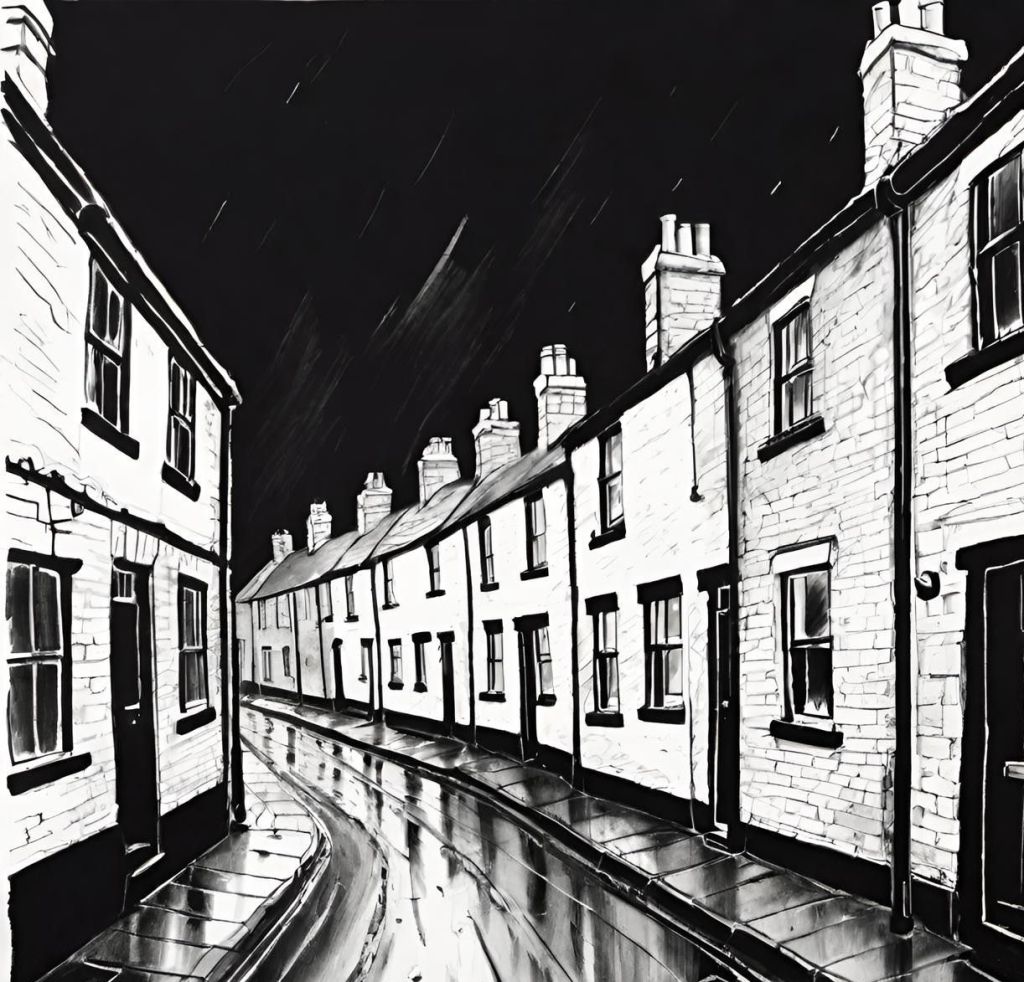
To reach the lane, one had to walk toward the colliery itself, about half a mile from the Station Hotel, past a long line of dreary old blue brick terraced houses, the likes of which might have been torn down in the fifties. Eventually, I came to a junction, where vehicles could access the site from the main road, and the pavement would follow the road down toward a number of low bridges that carried the rails serving the pit overhead. Despite the diggers and lorries in the main complex, there was an eerie silence about the place that served to exaggerate the already intense sense of abandonment and disrepair about the place.
There were gaps in fences, pot holes and weeds abound the old tarmac pathway, and panels missing from the street lamps exposed live wires to the elements.
Approaching the first of the over bridges, beneath which the narrow path veered to the right, the blue brick bridge supports obscured the route ahead, and the tip tap sound of foot falls, muffled voices and children’s laughter, distorted by the sound funnelling effect of the bridges preceded the passage of two young girls and their push chairs.
A light on the underside of the bridge flickered on and off and beams of light shone through between the girders above, while drops of water dripped rhythmically, seeping through the tracks above like a lethargic shower.
From that darkness, the pathway broke out in to daylight and climbed steeply up to the height of the track on the bridges before levelling off for a little. From here I could see coal wagons in the marshalling yard and the faded yellow skeletal form of an abandoned Coal Board locomotive, stripped of parts and rotting at the edge; and running parallel to the tracks, an enormous floodlight tower, rested where it had been felled and lay waiting its final fate.
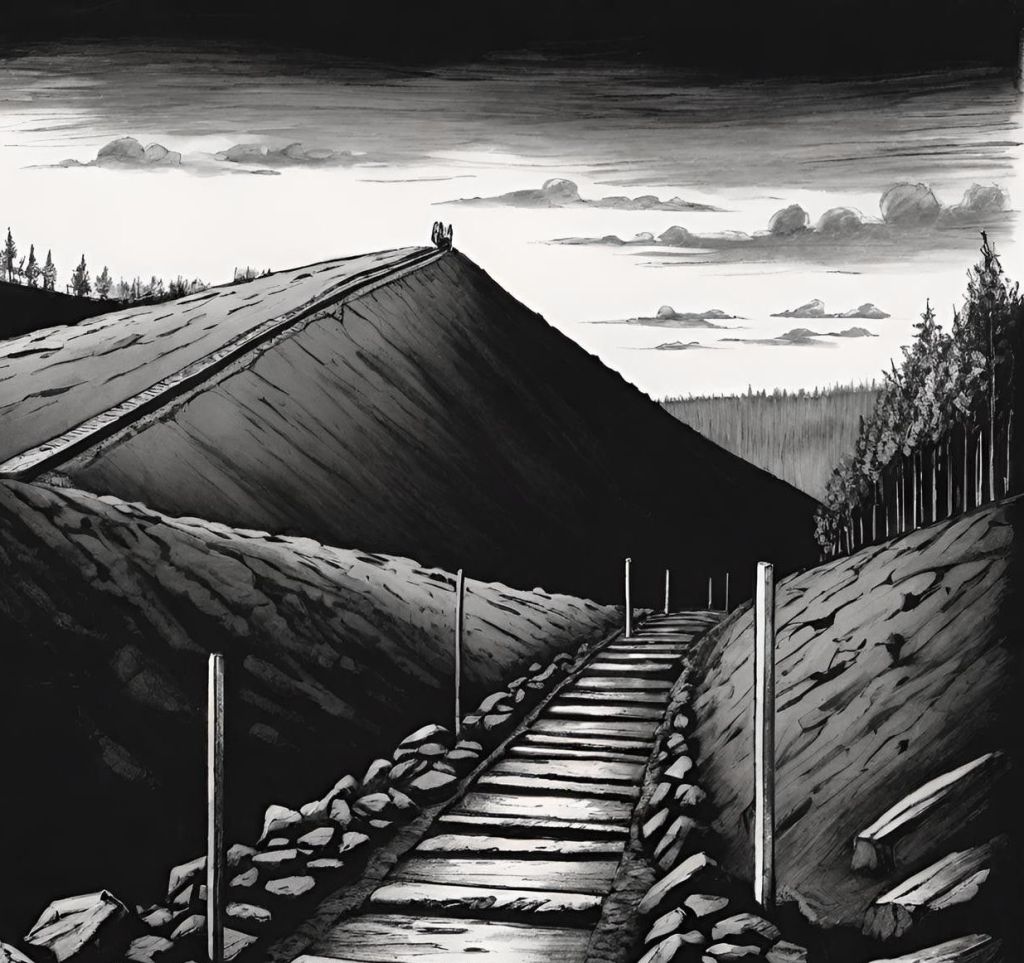
Onward the path began to climb in a long steady uniform line up the hill, bisecting the huge manmade mountain that had grown up over the years from the displaced material excavated from the mine.
The ascent itself was gentle, but relentless, and took a full fifteen minutes to reach the summit, but the view was reward enough. The surrounding countryside was beautiful, gentle slopes punctuated by woods and spires rolling in to the peaks of the Pennines, but in the foreground, a sprawling mass of black industry scared the landscape.
Sloping east from the summit of the path, the hill rose for a further five yards or so, though this was fenced off with a high metal chain link fence, and I overcame the usual impulse to trespass; all of the stories focussed on the path itself, so that’s where I would look.
I pictured Nige at home; laughing at the naïve southerner following a wild goose chase as I looked around the area he had directed me. There were no distinguishing features on the path, or along its edges; just grassy scrub, the fence, and the occasional tree.
It was easy to imagine, however, why these stories might arise. The whole ascent is quite isolating, even with the full daytime foot traffic, all of which smiled, or nodded, or greeted me with a firm Yorkshire Ay’up. But it was the unearthly stillness that seemed the creepiest. A hill like this should be windy, but the bulk of the hill seemed to protect this side from the prevailing easterly wind, and no sounds carried from the village or the pit below. I could see diggers, bull dozers and tipper trucks below clearing away the abandoned buildings, but there was no sound of this.
This I think was enough to settle my curiosity. I have come across few places so genuinely calm and incongruently spiritual as this one. It was too much to expect to actually see a ghost as well.
—
I returned to the B&B with a clearer head and a resolved appetite where I was fed a monumental serving of homemade shepherd’s pie, (made with beef mince I might add) and baked beans for some reason, and mushy peas, and a slice of buttered white bread. I coukd not recollect a time I had been so well fed and I decided to stay another night and try out the path under darkness, just to test my luck.
Once night fell, I dressed warmly and made sure I was kitted out with my ghost recording kit. It was nothing as fancy as the Ghost Busters might have; just a Dictaphone, a camera with flash, a torch and my homemade mobile barometer. Intrepidly, I stepped out into the night, fearful more of the disenchanted youths that loitered by the market stalls and the entrance to the unmanned Railway Station that might give me some grief than the ghost, but this evening was unusually quiet; it must have been a school night.
I retraced my steps from earlier that day through the deserted streets. It was blustery as before, but warm, and the low clouds passed swiftly above, illuminated by the deep orange glow of the argon street lights; the air itself heavy with the acrid weight of a thousand open coal fires.
Passing beneath those bridges was daunting. One could imagine an ambush, were one minded that way. A tale of ghosts on paths, a trap irresistible to the feeble southerner on his quest for knowledge, the men of the Working Man’s Club would lay in wait for their prey. I imagined.
I entered the passage that led down to the bridges, and again, they echoed with the chatter of others traversing the path, an ambush? The scent of old spice and Brylcreem preceded them, just moments before a small group of seniors emerged from the bridge, suited and booted, ready for their night at the WMC.
I passed the set of bridges without incident and began the accent. I rose up above the village, I could see the town illuminated beneath, but the old colliery works were shrouded in night. It must have been quite the sight ten years ago. The floodlight towers, now strewn across the marshalling yard, would have bathed the whole complex in a bright white light, and trains would be heard rattling around all times of day. For the villagers though, this was an unwelcome peace.
A brisk walk brought me to the summit after about ten minutes, and I allowed myself a break to catch my breath. Occasionally, I noticed, the wind must have dropped or changed direction, and the eerie silence would be replaced by the sound of traffic, a train passing on the railway below, or a bus toiling its way out of the valley, but as soon as it began, it would drop off again, and the hill returned to silence.
Occasionally though, I could hear, just at the edge of my hearing, the sound of children playing. There was a play area at the bottom of the hill, across the road from the start of the path, but this was in darkness too, and the children should be long in bed. Almost certainly another effect of the odd microclimate here, but then I noticed the lights on the ground and my imagination ran away with me.
Willow the wisp, marsh lights or corpse lights, as they are sometimes known. Tiny flames believed by some to spirits of children, believed by others to be nothing more than combustible gases seeping through the earth. Either way; this was only the second time I had seen such things, and the first time I had done so with a camera to hand.
I took out my SLR and began snapping, two frames at a time, one with flash, the other without. The strange little dancing lights took on a life of their own, and it was hard to even speculate on a rational explanation for them as again, I heard the muffled sound of children laughing, and it grew grow louder as I followed the lights on to the damp grass.
This was amazing, and far more than I could have hoped for, if not a ghost itself, then a rational explanation for the stories, and with pictures to boot. I even remember laughing out loud, scarcely noticing that the ground beneath me had become muddier, wetter, and a little spongy. Not until I felt something on my leg.
I froze on the spot, as the terror dawned on me. My foot was stuck in the mud, it was as if a hand gripped tightly to my ankle, and it took all of my strength, and the sacrifice of a boot, to break free, and when I did, I was so off balance that I found myself face down and struggling against the mud as each attempt to find my footing felt like another hand grappling with me, pulling me down. Panic began to set in.
Darkness surrounded me, but for the silhouette of my own arms flailing against the orange sky above as I grappled with some unknown attacker. I had strayed from the path and I would need to find solid ground if I was to escape the cold clutches of the treacherous heap.
Again, I felt an unseen hand on my ankle, and my leg sank knee deep into the mud. The struggle was exhausting, and the fight had disorientated me. It was all I could do to free my leg and roll on to my back, where I awaited my fate. I expected a final blow to finish me off, dragging me to muddy depths, but there was silence. The battle seemed to be over.
I lay there, quietly gathering my thoughts. Perhaps whatever foul creature had attacked me now thought I was gone, or dead, perhaps it too was blind and waited on my movements before it could attack again. Maybe it had gone for back up. Whatever the truth, I could not spend the night here. Already, I felt the mud around me rising, who knew how deep I might sink.
I cautiously looked around, unwilling to disturb the mud, but saw no distinguishing features against the turbulent sky above. Raising my head, I saw no sign of the path. Thoughts of my mortality ran through my mind, what would the papers say? Would my body even be found?
As the last of my hopes sank with my spirits, I caught sight of something to my left just in the corner of my eye. A figure in white stood nearby, but only when I looked away. Like the Seven Sisters in the northern sky that fade from view when directly looked upon; this figure too vanished when looked at. So turning my gaze to the right, the figure again appeared to my left. Was this the white lady? I remembered that she was always seen on the path in the stories, and whether she was the ghost, or a reflection of light from a road below, salvation was that way.
I tried to find my feet, but this only caused the mud to rise higher. A new tactic was required, and anything was worth a try. I tried rolling on to my front. This too was difficult, as the mud seemed to have moulded itself about my hulk, but eventually, with the last of my strength I managed it, and once moving, I burned my second wind to keep my momentum, rolling my way to the left, back toward the grassy verge and the refuge it offered. Exhausted, but on solid ground, I rested just long enough to find my strength for the hobble back to the pub.
—-
Almost two hours later, I arrived back at the Station Hotel, exhausted and barefooted on one side. Having passed no fewer than five people on the way, all of which greeted me politely, but none offered help. I pushed open the double doors and hobbled inside where the iridescent lamps brought my plight into deep relief.
“Goodness me” The landlady shouted from the bar, “Where the devil have you been?”
“Back up the pit lane” I told her,” looking for your white lady.”
“Did you find her” One of the old punters cried out.
“I think I did” I said, but I was drowned out by another
“Looks like you been rolling in the slag up there” one of the others warned, “Want to be careful up there”
“You could have died up there, what on earth is a grown man like you doing trespassing on the heaps” Beryl came round the bar and took me in to her care. “Let’s get you sorted upstairs”
“The heaps?” I said
“Yes” Beryl said, “now let’s get you out of these filthy black clothes”
I hadn’t registered how I looked. My suede jacket and corduroy pants were thick with black wet mud that was now starting to dry to a dull grey at the edges. My face and hair caked too. I must have been quite a sight walking through the village.
“Tracy” Beryl said to one of her staff, bring him a shot of Bells up will you”
I went upstairs to the communal bathroom and tried to the close the door behind me, but was surprised to find Beryl had followed me in.
“Come here love, stand in the bath while you get undressed, don’t want no slag on the floor. There’s a basket here for your dirties…”
She was interrupted by a knock at the door. It was Tracy with my shot of whisky.
“There you go love”, she said, placing the shot glass on the drawers by the bath, “I’ll leave you to it. Come down when you’re ready, I’ll have a steak and kidney pudding waiting down stairs.”
So I had a nice hot relaxing bath and reflected on my experiences, the absolute silence of the place, the laughter, the corpse lights, the unseen hand reaching out of the ground, and then the white lady herself. A lucky escape definitely, but it couldn’t be too good to be true. If only my train wasn’t the next the morning, I so wanted to visit the site again in daylight and gave thought to an early wake up call.
–
Hungry, I tore myself from the bath, put on a pair of jeans and woolly jumper and went back downstairs to the bar area, where, as promised a steak and kidney pudding and a generous portion of chips, peas and gravy were waiting.
“There you go love” Beryl said, handing the hot plate of food to me across the bar. “Get that down you”
I did as I was told and was left in peace to eat my evening meal, but ever aware that I was drawing some attention, and the very instant that my knife and fork hit the empty plate I was surrounded by men, and Beryl, her arms firmly crossed. I began to worry that I had broken some local taboo.
“Do you know how lucky you are not to be dead?” Beryl bleated.
“Bleedin idiot you are!” Another voice croaked from the back. What had I done?
“What did I do?” I begged, unsure what might follow.
“Did you not see the signs?” Beryl said again.
“Or the ruddy fence” someone else laughed out.
“It’s a slag heap up there! It’s like quick sand!”
“Aye, once the slag’s got you, there’s no coming back”
My heart began to pound, I had no idea of the dangers, but they were laid out to me, somewhat painfully and repetitively by the locals, whose concern was only matched by rare opportunity to teach a scholar something new. But things soon settled down, and the usual business of drinking returned to full swing and I was joined again by just Beryl.
“So did you find your ghost?” She said.
“I’m not so sure anymore” I told her. “I saw the marsh lights, but I can explain those, and for a moment, I thought I saw the white lady, leading me out of the mud”
“That’s not all though is it” she said. She could tell I was hiding something, and I confessed about the hand, but the triumph I’d felt before, of overcoming some monstrous being from the underworld, was now just the utter embarrassment at my naivety of all the industrial dangers that surrounded this place. I had simply got my foot stuck in some mud.
Instead of visiting the path again, I quietly gathered my belongings, packed my bags and made a discreet departure the next morning, but I did leave with a promise from Beryl that she would forward a number of newspaper cuttings that she had collected over the years about the ghostly reports in the area.
—–
Six months later, I was making sense of my notes and typing up accounts of my ghostly encounters across the hills and valleys of England. I had looked further into the tales I’d been told and was confident in both my subject matter, and the appeal of my latest book. Where the White Lady of the Old Pit Lane was concerned, I was most ambivalent. I certainly had a creepy encounter, and all of the stories checked out. My meticulous research uncovered several key truths in the myths that haunted the village of Thurnscoe.
Millicent O’Donnell age 17, hit by a train in 1907.
Victoria Connelly, raped and murdered on the Pit Lane in 1927
Marian Spitch, found dead in 1947, drug over dose
Henrietta Swardle, a milker’s Maid, trampled in the 1800s
There was an interesting history here, and maybe one worthy of a more substantial investigation, but I was also ashamed of my behaviour.
By sheer coincidence, it was at the very moment I had decided to drop the case of the White Lady of Old Pit Lane that I was given cause to reconsider. There was a knock at my office door and I opened it to see the college porter holding up a large brown parcel.
“Sign here” he said.
I took the parcel back to my desk and carefully open the letter that was attached with sticky tape to the top.
Dear Doctor Bosthwell,
As promised I have gathered up some of my newspaper cuttings from the local history group and sent copies. What I think will interest you more though is the local news from two weeks ago. In the 70s a young boy went missing, he was last seen following some older boys through Goldthorpe village, but when quizzed they said they hadn’t seen him. The area was searched, including the slag heap where you so foolishly wandered, but no body was ever found. It seems that search wasn’t thorough enough. That whole area is being reclaimed now and the diggers moved in just after you left us. You can guess what they found, and you can read the terrible details in the papers I have included, but what I think you’ll find most interesting is what was found in the boy’s hand. The police won’t release it to me; you’ll have to collect it yourself, but I have included the photograph they gave me…
My hands trembled as the thought of that gruesome struggle came back vividly to mind, and I turned over the enclosed photograph.
They say that nostalgia is good but it’s not what it used to be.
I’m a total nostalgia junky, I need no excuse to feel nostalgic, I simply can’t help myself.
On paper, the world is immeasurably better than it was. Most things are more reliable and readily available. But that just makes it bland. There is so little hardship now, that the little treats have no real purpose.
I was thinking just the other day about the frequent power cuts in the Seventies. I was very little at the time but remember the lights going out and the candles being lit. We would peer out the window and see the street lights were off, and our neighbors movements about their homes traced by the flickering shadows.
We would have toast made on the hot coals of the living room fire, drenched in real salty butter. And then be sent to bed with a candle to light the way. Toast was never so good in the toaster. Times were harsh but they gave us memories all the more cherishable for it.
The home of my childhood was torn down in the 2000s and replaced with affordable housing. The fields I played, are now affordable housing. My secondary school closed many years ago, even my college buildings have gone, Victorian blocks now towers of glass and steel. The market stalls are gone. Even the draughty old bus station, with its diesel fumes and greasy spoons, is gone.
Most of my childhood is now memory or museum pieces.
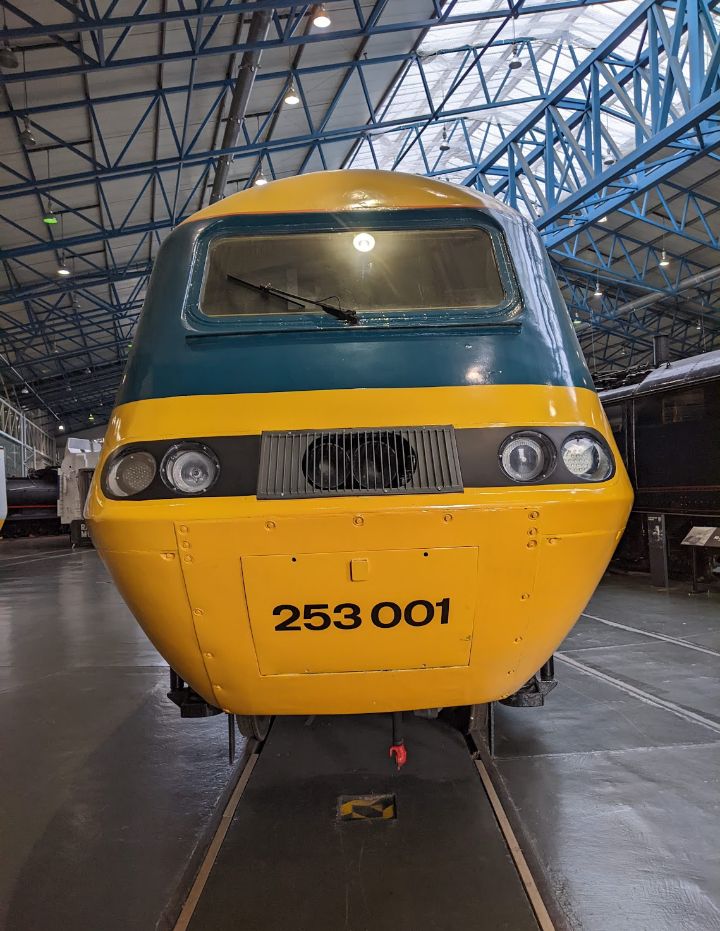
High Speed Train
My very first train set, was this High Speed Train. My first trip to London was on one of these. I felt like I’d been born in the future.
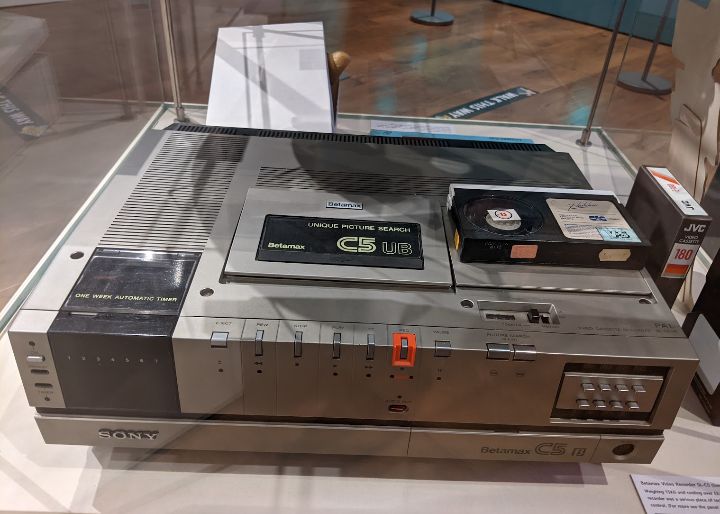
Betamax Video
We were the first on the street to get a video recorder. We could set the timer and record Coronation Street and Emmerdale Farm while we were on day trips to London. It really was the future.
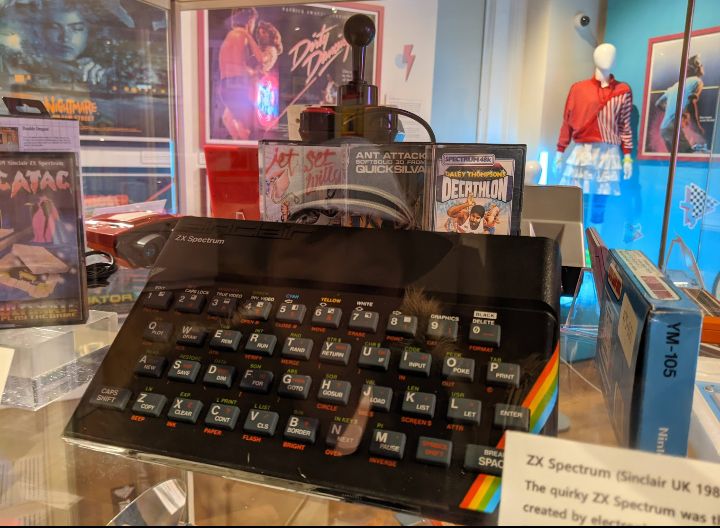
ZX Spectrum
The ZX Spectrum. A golden age video games.
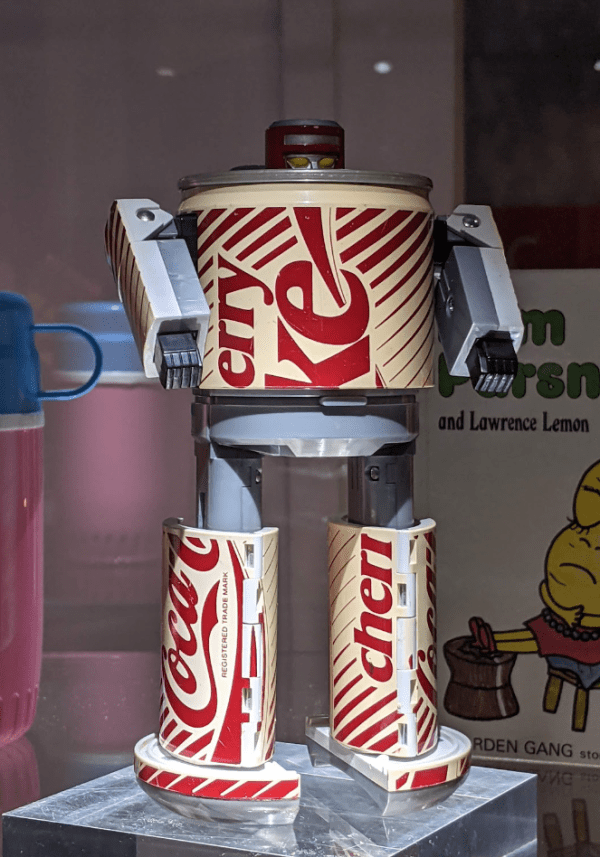
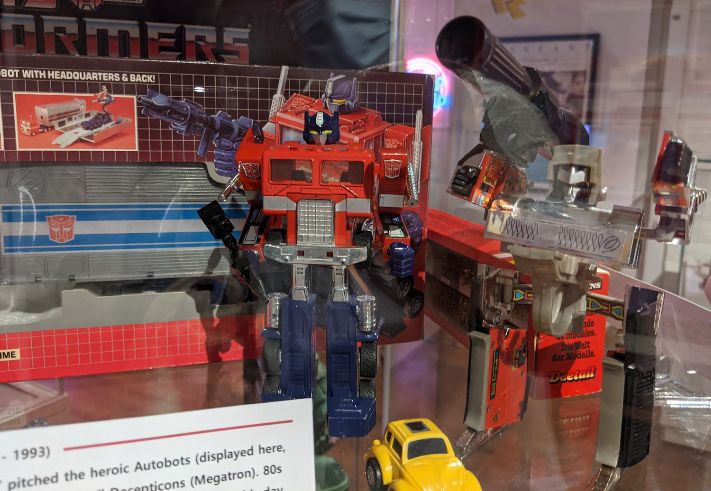
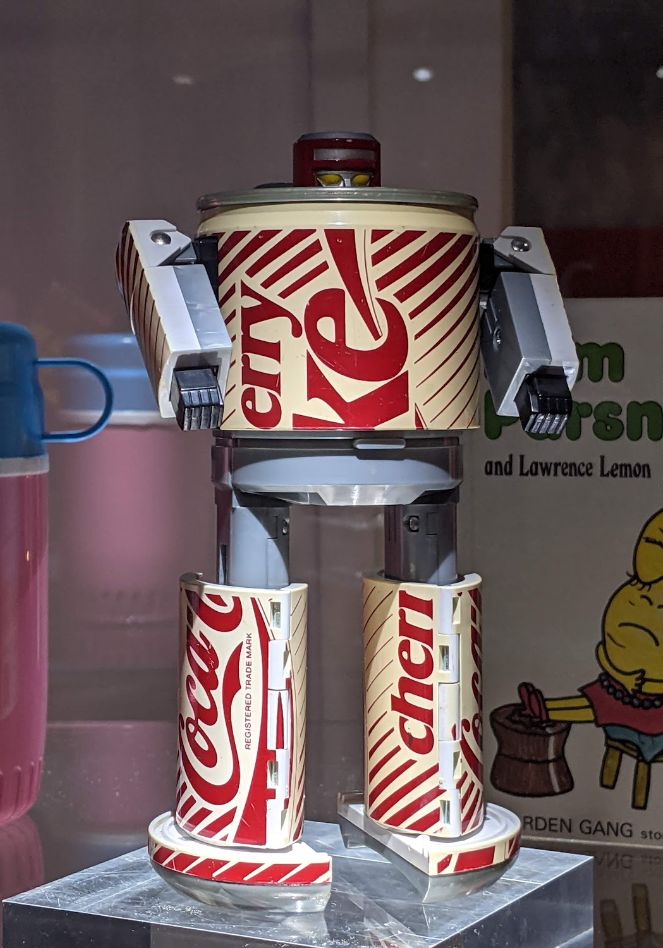
Robots in Disguise
The best toys were the Transformers. My first one was a Gobot, I still think about the hours spent playing with these, on my own, and with friends.
All of these pictures were taken in museums, Barnsley, and York. It’s quite sobering seeing our ‘now’ being preserved for posterity. We can no more stop the march of time than we can tell the tide to halt, but it’s fun to look back in simpler times.
My apologies to you again for missing our reunion this year at Grizedale. You may be aware that my Rachel, Dr Jennings, passed away earlier this year and with the early retirement of Dr Wallis at the end of April, the practice has continued to function, just barely, with two men short. Indeed, I have relinquished my additional responsibilities with the Commission to some bright young upstart, though I may confess to you that taking the lead in the End of Life review had begun to strike a little too close to home with these advancing years.
It is however my End of Life that I wish to pass to you. Learning from the experience and concerns of the Liverpool Care Pathway, I have spent considerable time liaising with our colleagues in the district and have taken on board the views of patients, relatives and colleagues on the matter, and have assembled a comprehensive set of guidelines, and an implementation strategy that I trust you will find most useful, should you choose to proceed. The work is not ready for publication, but I would be honoured if you deemed fit to follow through to implementation, and published with your own conclusions.
Also enclosed, as I’m sure you’ll have noticed, is the fruit of my lifelong study into what I have come to term cognitive pre-mortem. As well you know, I have long been intrigued by the persistent family tales of those experiencing prior warning before their death. I know this defies logic, but every ward I have visited has such a story, and I have heard them all.
I can imagine your face as you read this, it defies all.reason and possibility you say, and you are right, but I want to give you a summary of my findings that will hopefully whet your appetite enough to, at the very least, open my journals, and not just consign them to the shelf.
Take the case of Mr Barnham, for example. Both he and his wife were patients of mine for over forty years. I confirmed all of Mrs Barnham’s pregnancies, watched their children grow from new born to becoming parents themselves, and of course, I watched Mr and Mrs Barnham retire, and recede into old age. It was I that diagnosed Mr Barnham’s heart condition and it was I that referred him for a pacemaker, giving him a full extra ten years to spend with his wife. But it was also I that should have spotted Mrs Barnham’s cancer, but I didn’t, and with the voracity so typical of these tumours, Mrs Barnham was dead, just a month after her husband’s own life extending procedure.
Mr Barnham never held me responsible, not so I would know it, and certainly not to the extent to which I hold myself, but he always maintained that had he known he was to lose his beloved, he would never have taken the procedure.
Ten years after that procedure, Mr Barnham came to the clinic for a routine appointment, he checked out well, but at the end of the appointment he confided in me.
‘Doctor’, he said, ‘I saw Millie this morning, while I was in the shower’.
Millie was Mr Barnham’s wife. He explained to me that he’d been taking his shower before coming to see me when he felt someone enter the bathroom. He pulled back the shower curtain and there she was, resting against the sink, large as life. He asked her if she was really her, and she told him yes, they chatted about things, the grandkids she’d missed, how he’d missed her, but she knew this already, she was never really far away.
This is all right up my street and I wanted to know more, but there wasn’t really anything else to tell. Mr Barnham had had a catch up chat with wife, like he had just returned from being away on business for a week or so. There was no terror, no creepy chains or spooky mist, but she did tell him that they would be together again soon. I always imagined if I’d been in that situation I would have panicked, but he was calm. It wasn’t a warning, it was a promise, and he seemed at peace. He left me with a skip in his step and a gleam in his eye.
That afternoon, the call came. The body was found resting in his arm chair by his daughter, and I went out to pronounce the death. He was indeed at peace, and his expression was blissful. He had spent the morning settling his accounts and left this world with his affairs in order.
This is just one account, there are many, and I know you have heard them from your own patients. I firmly believe that there is something in this and it’s conscious enough in the public psyche that it should be accepted in the media. Take Lou Beale or Jack Duckworth for example, but jokes aside I have so many of these examples, but I’ll give just two more.
This is the case of the ICU patient at Morecambe General. The particulars of the case are all recorded in both the history sheets in the patient record, and in my own journal, and the family have agreed to participate in further studies of this encounter should you deem to pursue it.
The patient in question, a young man in his late teens had a rather nasty meeting between a sheep and his motorcycle up on the Quernmoor Tops, which put him in a coma, but his condition only deteriorated further, eventually being placed on life support.
This family is well known to me also, being registered to my practice, and I called in to offer my support whenever I was passing ICU. It never did look good for the poor chap and it reached a point where the question of switching off the machine had been asked.
As you know, this is a decision that we all hope that we never have to make, and what happened next, I can at least validate myself.
It was late evening and following an over running project meeting, I was catching up on my emails in the ward manager’s office before going home when I caught sight of the back of a patient pass the office door and walk down the corridor. I didn’t think much of it at the time; it is after all a hospital. There are patients wandering around all the time; it was only once the patient had left the ward that I realised that something was amiss. It took a moment for me to register that on the intensive care ward, patients are not prone to getting up to stretch their legs.
I put my head out of the office door expecting to see who ever it was that had passed standing by the ward doors waiting to be let out by the attendant, but there was no one there.
Downstairs however, the patient’s mother, whom we will call Mrs Smith in the interests of information governance, was stood at the coffee machine by the reception desk staring through her options when she felt a hand on her shoulder. Expecting her eldest son to have caught up with her, she didn’t look up, but a voice said, Don’t cry mum.
She wept and told her son that she couldn’t do it, she couldn’t be the one that ended her son’s time here, the one that admitted all hope was lost. That she was giving up. But the voice said that it was ok, that he didn’t mind.
Mrs Smith was furious her other son, Peter, could even think such a thing, and she turned to give her adult son a thick ear, but it wasn’t Peter, it was Paul stood there, in his hospital gown, but not a scratch on him.
She cried, asked him what he was doing out of bed, was he feeling better? But the answer was no. He had come to goodbye.
She was calm, she told me, very calm under the circumstances. It was later that she would freak out.
Paul told her that he would wait for everyone to arrive, but that he was ready to go now. Mrs Smith flung her arms around him, held him as tight as she could, and asked him to stay. She told me later that her son was soft to the touch, and had all the scents and feel of a baby, the way she always viewed both her sons. And then he was gone.
The next part I can corroborate as I was there. Mrs Smith pounded on the ICU doors, demanding to be let in, but as the reception desk was abandoned I used my own pass card to let her in. She dashed right past me and down the corridor, in to Paul’s room.
I followed her down.
In the room, the whole family was assembled and Mrs Smith had rested her head on her son’s chest, weeping, she told him everything she needed to say, everything that had to be said, and everything he’d always known to be true; and that he would never ever be forgotten.
Then he flat-lined: the DNR tag prevented the crash team invasion.
I stayed with family a while, eventually sitting down with Mrs Smith with a cup of tea in the office. She told me what had happened down stairs, and that she was at ease now that she’d had that one last goodbye, and how relieved she was that she didn’t need to pull the plug herself.
Now you know me, I’m a believer, but I also remain sceptical of each case I encounter. Morecambe General is a big hospital, if a patient had walked down the corridor, he should be on the security cameras right? I checked, and during that exact time, a circuit board had blown, knocking out every camera for three minutes. When they did come back over. It was all over.
There are lots of coincidences that I have found during this lifelong study of mine. Coincidence beyond reason, but coincidence nonetheless; it is almost as though the world itself conspires to maintain the shroud of uncertainty around the truth of our eventual fates, and all the evidence that I can provide, is ultimately anecdotal.
Despite my best efforts, it is here that the world continues to outwit me, but what that security recording did show me, is Mrs Smith dropping her arms, as if from a deep embrace with an unseen companion, and then she runs to the lift (The video file is in the notes too).
I know you too well to know that this alone is not enough to sway you, but I hope you will at least review the materials that I have sent as I fear I have run out of time myself; if there is any truth in the stories I have recounted to you, this will be my last correspondence. Despite the clear bill of health, I received this morning a visit from Rachel, beautiful as the day we met, and she told me, as the others have been told by their loved ones, that I will see her again quite soon.
Pardon me, if you will, while I lament the Christmas dichotomy.
I was not raised a Christian, but we followed the traditions. I was raised not to follow Jesus but to worship Santa, the bringer of train sets. It was only later in life that I picked up a bible and the penny dropped. Don’t do the things that are bad for you, sin, and you suffer the consequences of having done the things that are bad for you. It seems obvious now, but anyway.
It turns out that there are 137 of these sins, but the ones that raise their heads at Christmas are obvious.
Gluttony is the big one. At this time of year we open our gullets to all manner of lavish self indulgence. I enjoy that.
Carousing. For the longest time, carousing was the best part of Christmas. For me.
Envy, coveting, greed. Everyone seems to be having a better Christmas… perhaps, perhaps not. The media machine seems hell bent in giving us this impression.
Drinking and drunkenness, also bad. It’s expensive, gives you hangovers, ill health, and a bunch of bad decisions. I can see why this is bad. I usually spend much of Christmas day inebriated, imbibing glass after glass while I prepare the Christmas dinner.
I take pride in my roast potatoes. My roast potatoes could stop wars, end all suffering, all pain, all disease, all poverty, all hunger. My roast potatoes really are that good. Pride goeth before a fall.
But what’s the alternative? A low effort Christmas dinner? Steamed Turnips? Who wants that? Surely we are allowed in moderation to indulge but once a year, at least.
My roast potatoes are amazing, I’m told.
I will have to ruminate on this matter further. It is a proper dichotomy.
Not sure who to attribute this question to, I’ve been asked it by everyone. Colleagues, the woman at the chippy, my mam, the kids. That literally is everyone. And I heard someone on the train asking someone else.
Am I set for Christmas? 🎄
No. I don’t think that I am.
Sure. The tree is up. And we’ve got a dining table this year, so there is that.
Most of the presents are sorted for the kids. Not that they ask for much anyway. I haven’t wrapped them yet though.
We’ve done Christmassy things with the school. Church fate, tombola. All that stuff. Trip to the Panto for the youngest.
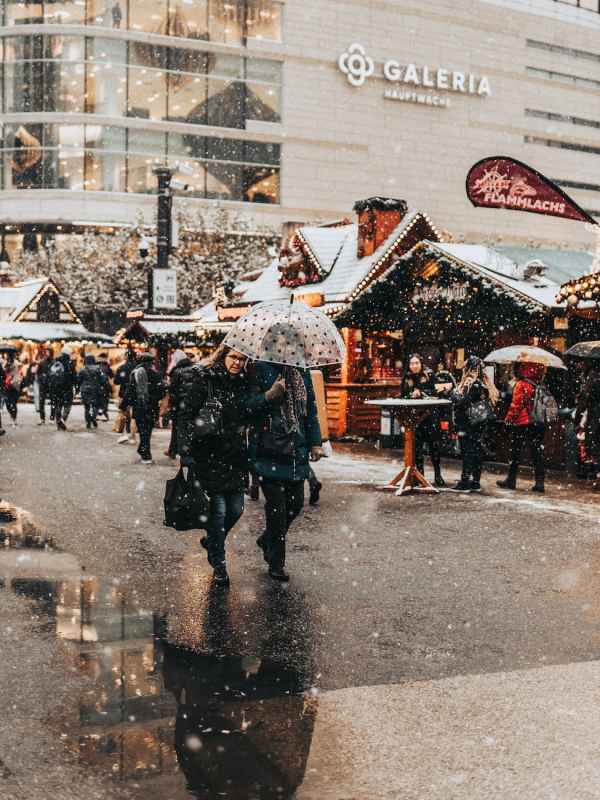
We’ve been to the Christmas fair. Endured the madding crowds that we can enjoy hot coal roasted chestnuts and hot mulled wine on the ice cold cobbles of a foggy medieval town while listening to street music.
We watched our first Christmas movie of the season, not Die Hard, but Scrooged. We recently watched Yippee Ki Yay at the local theatre and I’m all Die Harded out for now.
There will be other Christmas movies, Polar Express, Muppets Christmas Carol, and it wouldn’t be Christmas, legally, without It’s a Wonderful Life. I’m not really about the Christmas movies, it’s more about the ghost stories that go so well with the season, and the Nativity, obviously.
Christmas for me doesn’t kick in until the house falls silent on Christmas Eve. When the kids are finally asleep. When the last of the presents are wrapped and positioned under the tree 🎄, and I scare myself giddy watching the old M R James episodes from the BBC by the light of the tree.
But am I ready for Christmas?
Not particularly. Not even turkey dinner and work disco, and two ghost story productions (Casting of the Runes, and The Signalman, both excellent btw, go see them) have got me in the mood.
We still have to visit family and friends about the country. Still need a few pints with my drinking bud. We haven’t done the pantomime yet. We always try to get the final performance before Christmas, the atmosphere is fantastic.
But let’s get to the heart of the matter, the title of this piece. The Shuddersome Shopping Season. I just don’t understand it.
It’s one day, and everyone goes nuts. Christmas dinner is Sunday Dinner, but with more choices. I’d be lying if I said that I made pigs in blankets, sausage meat stuffing, coca cola ham, turkey, goose fat roast potatoes, honey glazed parsnips, extra buttery mash, roast rainbow carrots, cheesy cauliflower, baconised sprouts and chestnuts, and two types of gravy every sunday, but roast dinner is roast dinner. There’s no need to go crazy at the supermarket.
I can understand that some people will be feeding large family groups, catering to guests and having to buy extra, but the number of people eating is static, is it not? The people at the shop buying crazy amounts of food must surely be offset by the people that don’t need to buy crazy amounts of food because they’re being catered for.
I am keen, this year, to not do that. There will be Christmas Day extras. Smoked salmon butties for breakfast, plus the bucks fizz to wash it down, for example. And I will spend all morning in the hot kitchen, drinking wine, listening to Radio 2, while I chop the veg and thicken the gravy. I suppose by then, I will be ready for Christmas.🎄
I don’t want to be an AI bore but it’s here isn’t it, and there are questions to be answered. While publishers launch legal battles over AI systems being trained on their intellectual property I am concerned with smaller questions. It’s no secret that AI does not create, it plagiarizes so AI work cannot be considered original and unique, so I cannot claim IP ownership of anything it produces for me.
But that got me wondering, what about the prompt it used? Let’s say that I wanted to write a short story about a man tinnitus discovering that the buzzing sound that had haunted him his entire life was actually the ghost of a bumblebee that he trapped in a draw thirty years earlier. I don’t have time to write this story myself, I’ve got washing up to do, but I could put the idea, my idea, I own the IP on the story idea, into AI. What would the legal standing be then? It’s my story. If I used AI to calculate my taxes, it’s still my taxes.
I wouldn’t do this of course. I know that even my worst output on a very bad day is still better than AI, but curiosity got the better of me at the exact moment that I needed a block text to test the twitter character limit on my verified account. I haven’t even read this myself, but if the movie rights were ever in question, they are undoubtedly mine.
Can you write a short ghost story, 3000 words, about a man suffering since childhood with tinnitus, learning to his horror that the buzzing sound he’d heard his entire life was the ghostly cries of a ghost bee that tied after being deliberately trapped in a desk drawer.
My prompt
The Buzzing of the Bumblebee
The buzzing sound had been with him for as long as he could remember. It was a high-pitched whine that never seemed to go away, no matter what he did. He had seen doctors, tried different medications, and even tried meditation, but nothing seemed to help.
The man’s name was John, and he was 35 years old. He had lived with tinnitus his entire life, and he had learned to just ignore it. But lately, it had been getting worse. The buzzing sound was louder and more persistent, and it was starting to interfere with his work and his personal life.
One day, John was working in his office when he heard a strange noise. It was a high-pitched whine, just like his tinnitus, but it was coming from somewhere outside his head. John got up and went to investigate, and he found the source of the noise in a desk drawer.
Inside the drawer was a dead bee. The bee was small and black, and it was covered in dust. John had no idea how the bee had gotten in the drawer, but he was sure that it was the source of his tinnitus.
John took the bee out of the drawer and examined it. The bee’s stinger was still intact, and John could see that it had been crushed. He realized that the bee had been trapped in the drawer and had died of starvation.
John felt a pang of guilt. He knew that he should have let the bee out of the drawer, but he had forgotten about it. Now, the bee’s ghost was haunting him.
John tried to get rid of the bee’s ghost, but it was no use. The buzzing sound continued, and it seemed to get louder and louder. John started to have trouble sleeping, and he was always on edge. He was afraid that the bee’s ghost would drive him crazy.
One night, John was so tired that he fell asleep in his office. He dreamed that he was back in his childhood home, and he was playing in the backyard. He saw the bee, and he tried to warn it not to go into the desk drawer. But the bee didn’t listen, and it was trapped.
John woke up in a cold sweat. He knew that he had to do something to stop the bee’s ghost. He went back to the desk drawer and took out the bee. He buried the bee in the backyard, and he said a prayer for the bee’s soul.
The next day, the buzzing sound was gone. John was finally able to get some peace and quiet. He knew that he would never forget the bee, but he was glad that its ghost was finally at rest.
John’s story is a reminder that even the smallest creatures can have a big impact on our lives. The bee’s ghost may have been annoying, but it was also a reminder of John’s own mortality. The bee had died, but John was still alive. He had a chance to make a difference in the world, and he was determined to do so.
John went on to live a long and happy life. He never forgot the bee, and he always made sure to let any trapped insects go free. He knew that even the smallest act of kindness could make a big difference.
What’s your favorite game (card, board, video, etc.)? Why?
I don’t play games anymore. Except for Family Games Night, then I play games. I can’t say that I have a favourite though, just whichever is the flavour of the day and that gets played to death, until we get bored and never touch it again.
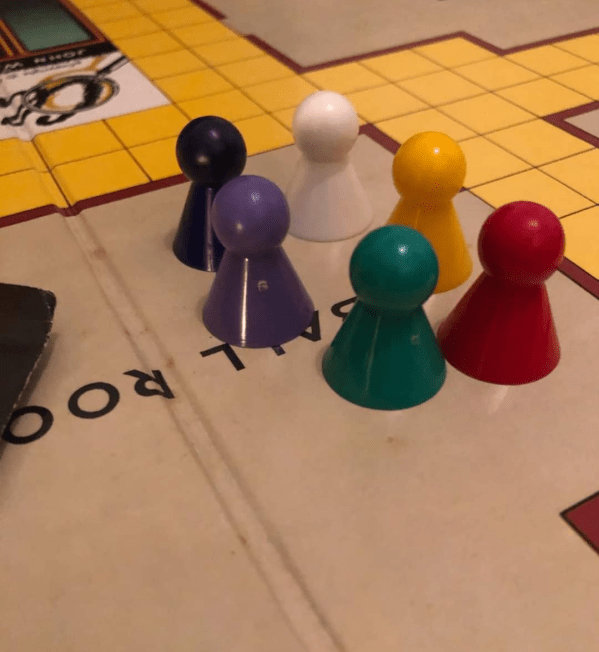
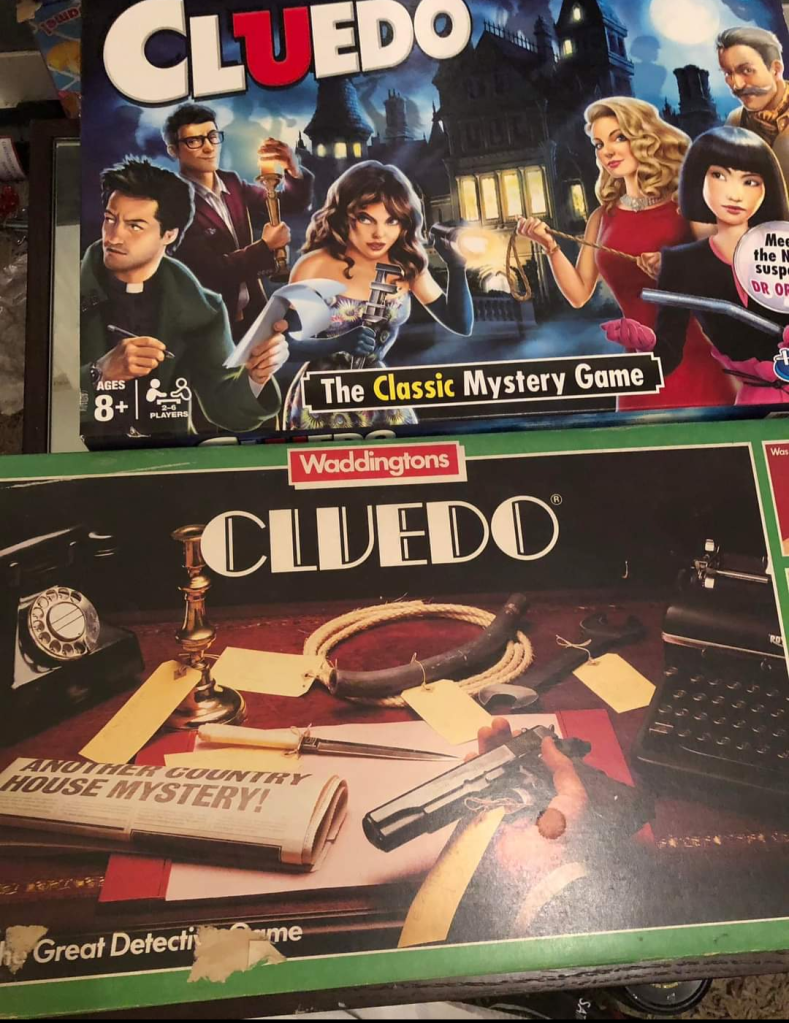
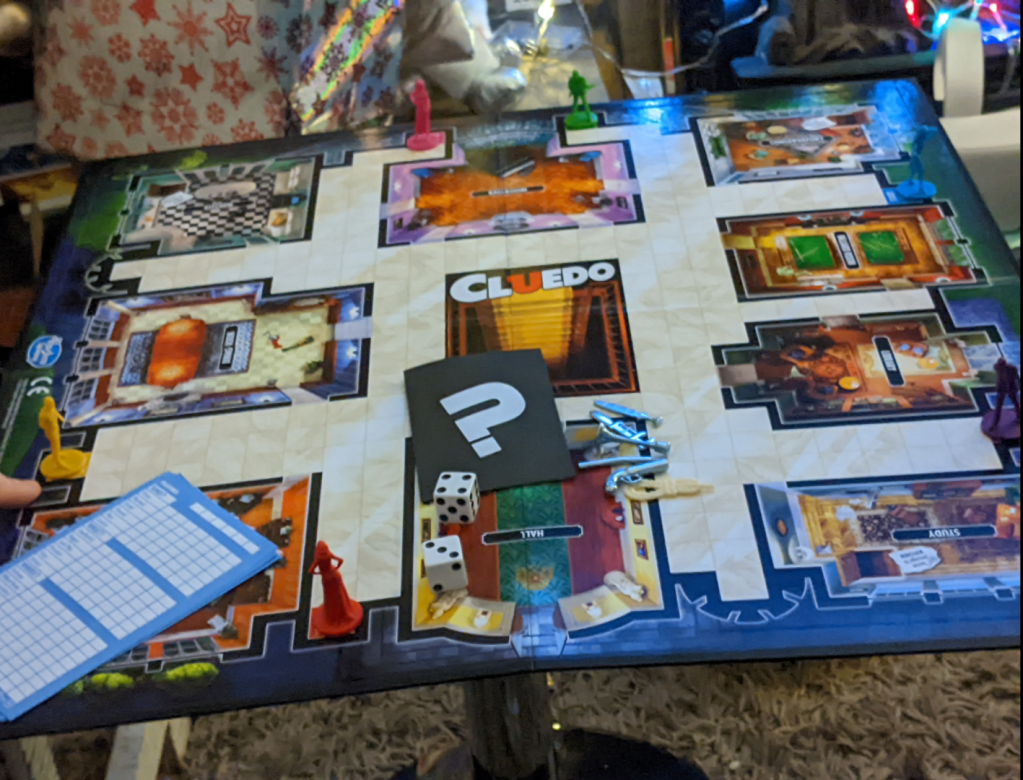
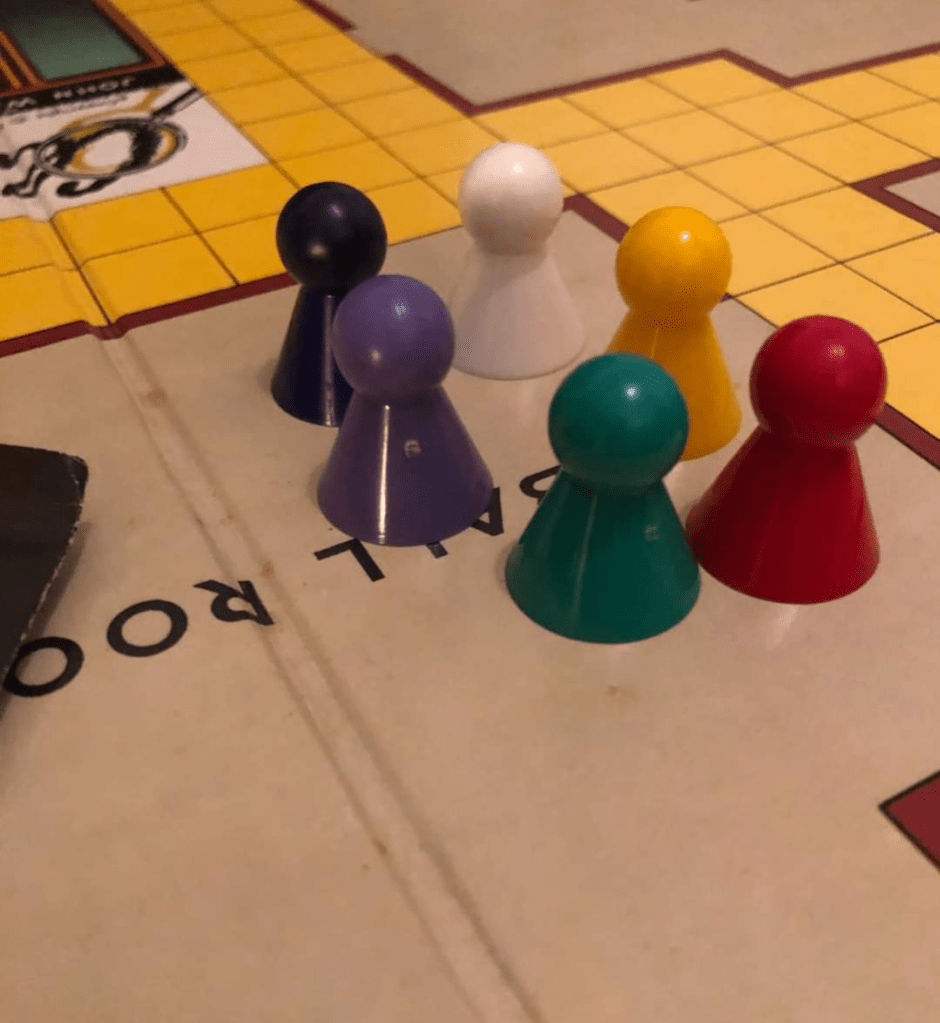
At the moment, that game would be Cluedo, or Clue, for my American friends. We’ve got two versions. The modern one, and the classic.
We also play Soggy Doggy, but that involves water and batteries. For a long time though Monopoly was my all time favourite, but it goes on for so long, and ruins friendships, so that went into storage long ago.
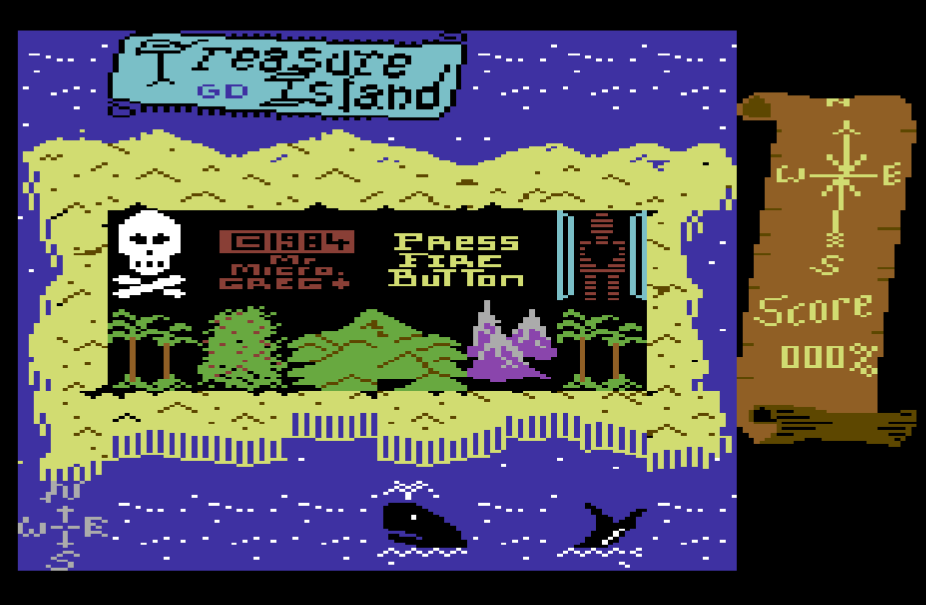
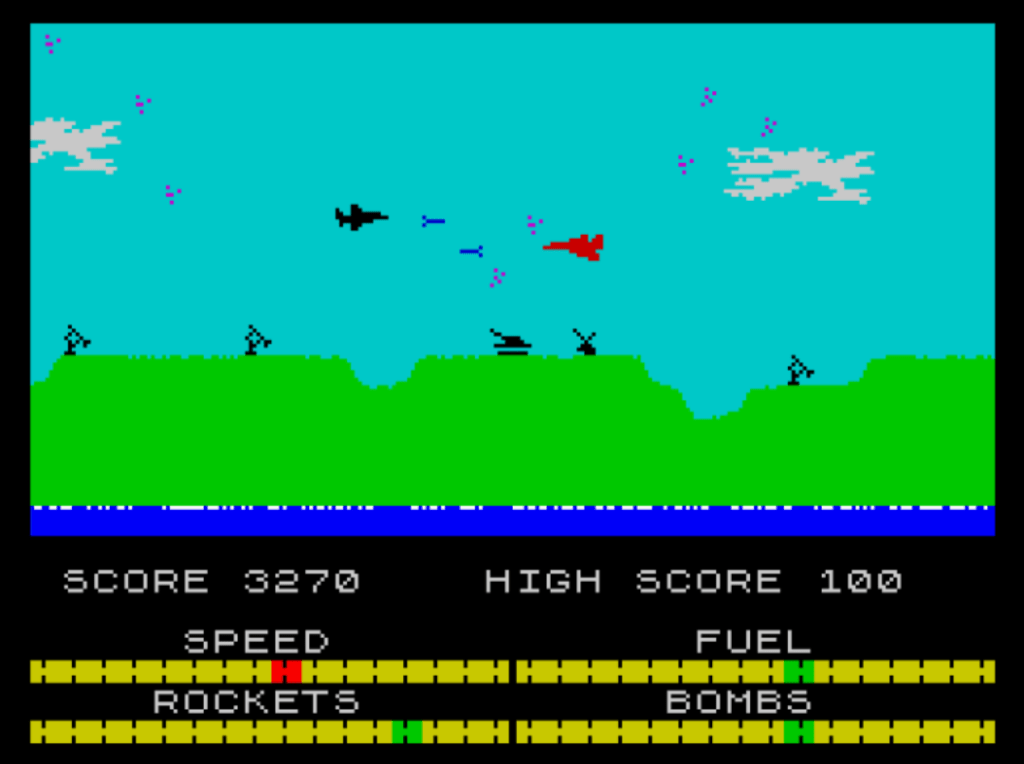
I was always more of a video game player. My first computer was the zx spectrum and for the first week it was set up on the TV in the living room, and the whole family got involved. We played such games as Harrier Attack, Oh Mummy, and Treasure Island into the small hours.
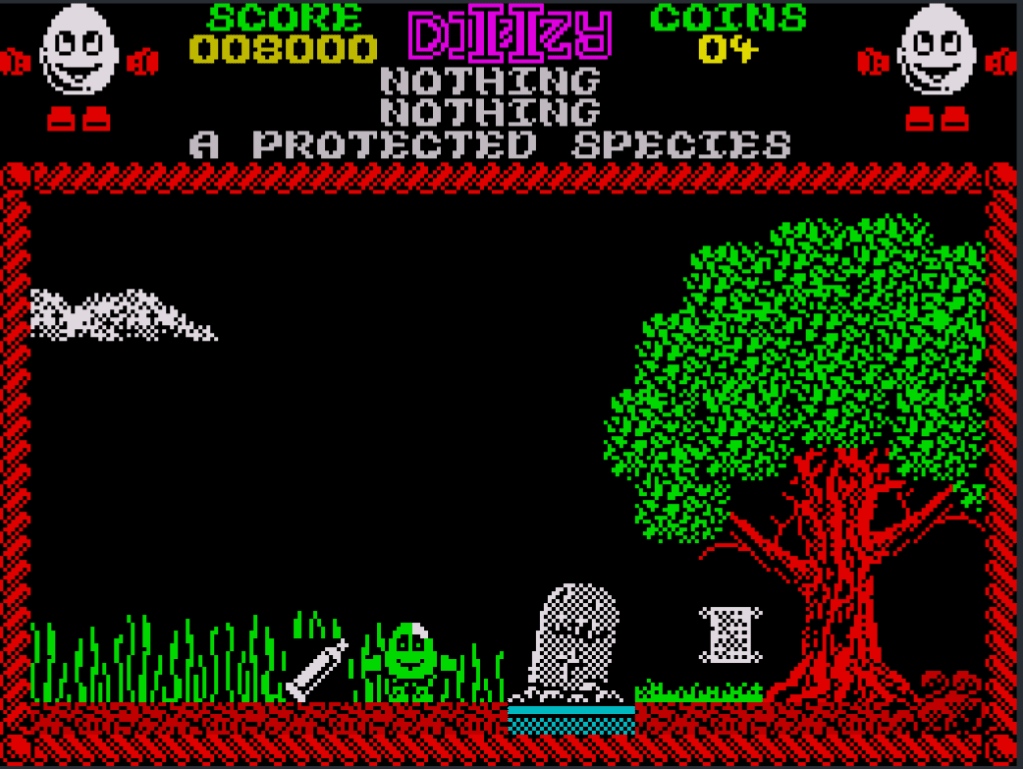
There were thousands of games, but the one that captures my imagination most was Dizzy, and all of its clones and spin-offs. It kept me entertained for years.
Dizzy was a boxing glove wearing egg that bounced around the screen solving puzzles. The setting didn’t matter, the main interest was exploring the world, collecting objects and finding their purpose to unlock new parts of the game. It was almost as good as going outside.
They don’t make games like this anymore, and the more the graphics have improved the visuals, the less the imagination is fired. In a modern game, what you see is what there is, but in a low resolution game the world implied by visual prompts is way richer.
Something about that grave ..
It didn’t matter that the graphics were simple or that the colours clashed. There’s long grass here and you can smell it, hear the insects beating their wings. The tree is old, the wind rustles its leaves and its branches sway and creak, this tree could tell a tale or two. But that gravestone, it’s been there for a while and it’s started to sink, soon it will topple and disappear in to the ground, taking it’s secrets with it. Could there be something buried here? Treasure? A secret entrance?
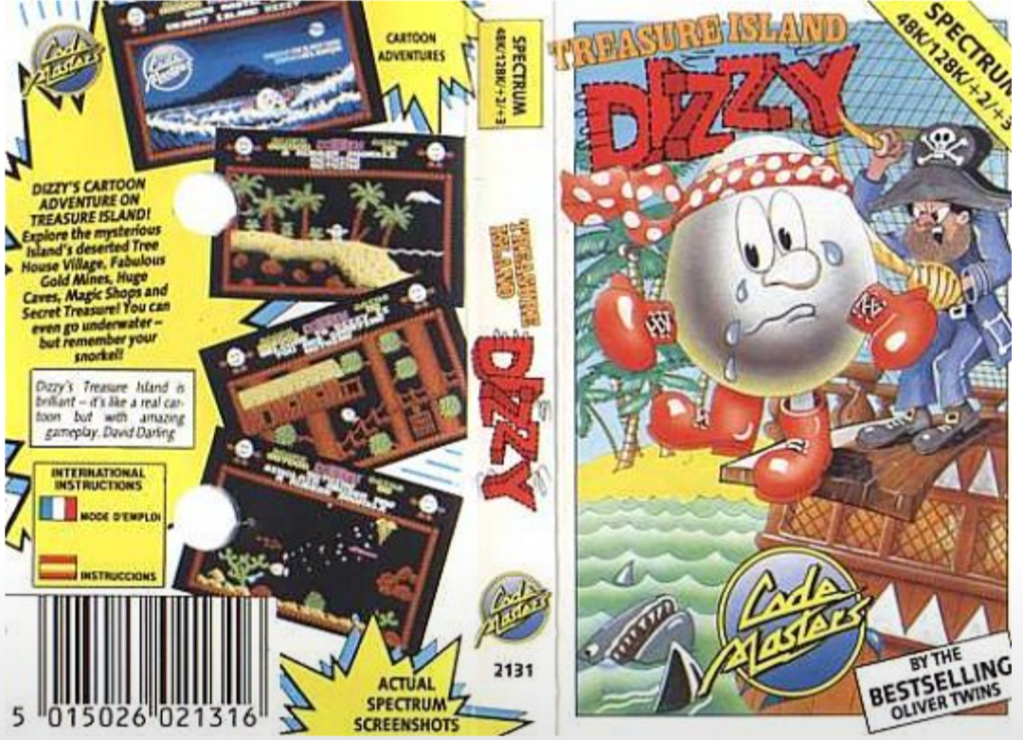
I picked up this game on a trip to the seaside in the eighties. I read the packaging, consumed its treasure island themed art work with the sun on my face and the sea air in my lungs interwoven with the anticipation of playing the game when I got home, 3 long hours later. Memories like that can carry you from childhood to deathbed in a way that instant downloads never will.
I’ve played many games since. Blood, Grand Theft Auto, Bendy and the Ink Machine. There are good games but they don’t have the simplistic beauty or the imagination of the classics.
I can’t name an all-time favourite, there are just too many, but many have left an indelible soft spot.










 Duggan's Dig